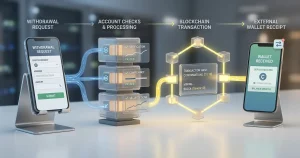


Open Banking links the cashier to a bank-authorised payment, but screens, costs and processing times can vary by provider.
How Open Banking connects a casino to your bank
Open Banking lets you authorise a payment from your bank account through a service that connects the casino’s cashier with your bank. Instead of entering card details, you select a bank-payment option and follow the instructions to approve the transaction. Depending on the service, that may involve being redirected to your bank or confirming the payment in its app.
The casino does not need to handle your card number for this route. Your bank authenticates you and asks you to approve the payment; the payment service passes the instruction between the bank and the merchant. The exact screens and steps depend on the provider and your bank, so the process can look different from one cashier to another.
This is not the same as giving a casino your online banking password. You should authenticate through your bank’s own secure process, not disclose login credentials in a casino form or to someone claiming to arrange a payment. Read the authorisation screen before confirming: it should make clear what you are approving and who is receiving the payment.
When choosing a casino for direct banking, you may also want to check the available information about payouts. This list gives you the stated payout speed for each operator.
1. BeOnBet
Payout speed: 1-3 business days BeOnBet lists a payout speed of 1–3 business days, giving you a stated timeframe to consider.
2. WinBeast
Payout speed: 1-3 business days WinBeast lists payouts as taking 1–3 business days. You can use this stated speed when considering your options.
3. SpinFormula
Payout speed: 1-3 business days SpinFormula gives a payout speed of 1–3 business days, offering you a clear timeframe to note.
4. SlotoSport
Payout speed: 1-3 business days SlotoSport states a payout speed of 1–3 business days, which you can factor into your choice.
5. Chanze
Payout speed: 1-3 business days Chanze lists a payout speed of 1–3 business days. This gives you a stated estimate for payouts.
6. NightWin
Payout speed: 1-3 business days NightWin’s stated payout speed is 1–3 business days, a timeframe you can keep in mind.
7. Britsino
Payout speed: 1-3 business days Britsino lists payouts as taking 1–3 business days, giving you a specific stated timeframe.
8. Zombillion
Payout speed: 1-3 business days Zombillion states a payout speed of 1–3 business days, which may help you assess timing.
9. Revery Play
Payout speed: 1-3 business days Revery Play lists a payout speed of 1–3 business days, giving you a timeframe to consider.
10. Dieselwin
Payout speed: 1-3 business days Dieselwin gives a stated payout speed of 1–3 business days for you to take into account.
A card payment follows a different path. You enter or select card details, and the transaction is handled through the card network and relevant card providers. With Open Banking, the payment instruction is linked to your bank account directly through the connecting service. Neither route removes the need to check that the payment is being sent to the intended recipient.
A separate e-wallet adds another account between you and the casino. You may first hold funds in the wallet, then use that wallet to pay. Open Banking is not simply a wallet with a bank logo: it authorises a bank-account payment rather than requiring you to route funds through a separate stored balance. A payment provider can still be involved in making the connection, but that does not mean you have opened or funded an e-wallet.
The distinction matters when you are deciding what information to enter and which account is involved. For a direct bank payment, the relevant account is the bank account selected during authorisation. The casino account and the payment route should belong to the same person. If the casino profile is in your name but the bank account belongs to somebody else, the mismatch can create avoidable questions about who made the payment and who is entitled to the funds.
Keeping those details consistent does not guarantee that a transaction will be accepted or prevent every verification request. It does remove one basic source of friction: the casino can more readily see that the customer named on the gambling account is also the person associated with the payment. Use your own account information and a payment route connected to an account you control.
TRON TRX Casino Comparison for UK Players · Diners Club Casinos in the UK: Deposit Availability
Open Banking may also be described as a way to make a bank transfer from within the cashier. The labels are not always used consistently, and a bank transfer started manually through your banking app is not necessarily the same process as a payment initiated through an Open Banking connection. In the latter case, the cashier or its payment provider guides you through authorisation and sends the payment instruction to your bank. With a manual transfer, you may instead have to enter recipient details yourself. Check what the cashier actually asks you to do rather than relying on the label alone.
That distinction can affect how much effort is involved, but it does not establish how quickly a particular casino will credit a deposit. A specialist review may describe Open Banking or bank transfers as providing instant deposits and fast withdrawals at many sites; that is a reported possibility, not a timing commitment for every casino, bank or transaction. The route explains how payment authorisation works, not what happens after the instruction has been sent.
Before approving a payment, check that the bank account shown is the one you intend to use and that the casino account carries your own details. If a payment fails, avoid repeatedly authorising it without checking whether money has already left your bank account. Look at the transaction status in your banking app and contact the casino or payment provider through its official support channel if the outcome is unclear.
Attention: You should authenticate through your bank’s own secure process and never disclose login credentials in a casino form or to anyone claiming to arrange a payment.
For anyone comparing Open Banking casino sites in the UK, the useful starting point is understanding this connection: the payment is authorised through your bank, while the casino receives the payment through a connecting service. That makes it distinct from entering card details or paying from a separate wallet, but it does not remove the need to check the payment instructions, account ownership and transaction status.
What “direct banking” means at the cashier
“Direct banking” is a broad label, not a guarantee that every casino uses the same payment arrangement. At the cashier, it generally points to a route in which your bank account is involved in moving money to or from the gambling account, rather than a separate payment account being the obvious intermediary. An Open Banking casino may present a bank-linked option under its own payment label, so the wording alone does not tell you exactly how the transaction is handled.
The useful question is not whether a cashier uses the phrase “direct banking”, but whose account is connected to the payment. The account used to fund a casino balance should belong to the person named on that gambling account. Keeping those details aligned gives the operator a clearer basis for treating a deposit as yours, rather than having to resolve a mismatch in ownership.
That is why a consistent named account can make the payment relationship easier to follow. If you deposit from one account and later request funds to be returned to that same source, the route has a straightforward connection between the two transactions. It does not guarantee that a payment will be approved or processed without checks; it simply avoids adding an avoidable question about who owns the account.
Casinos That Accept Dogecoin in the UK: What to Check · Casinos That Accept E-checks in the UK: What to Check
This matters whether the cashier calls the option a bank payment, direct banking or an Open Banking payment. The label may describe the route, while the account details establish the relationship behind it. When choosing a payment option, check that the account you intend to use is in your name and that the casino account has matching ownership details. Do not use another person’s bank account to get around a failed payment or an account restriction. A payment that appears to work at first can still create a problem when the operator reviews the transaction.
The same principle applies when money is returned. Anti-fraud and anti-money-laundering controls commonly involve sending funds back to the original payment source. In practice, that means the account used for a deposit can matter later, even if you are thinking only about getting money into the casino balance today. A casino may consider another destination, but an alternative can call for additional verification. It is sensible to understand the intended return route before you make a deposit, rather than assuming that any bank account you nominate later will be treated as interchangeable.
For an Open Banking casino in the UK, therefore, “direct” should not be read as “unrestricted” or “anonymous”. Your payment still has an identifiable account behind it, and the casino may need to establish that the account belongs to you. The route is best understood as a way of linking a payment to your own bank account, not as a means of avoiding the operator’s checks.
Do
- Use personal account details matching your casino profile
- Keep a record of the funding source used
- Confirm the intended return route before depositing
Don’t
- Use another person’s bank account to bypass restrictions
- Assume “direct banking” means the process is anonymous
- Use a different account for deposits and withdrawals
A simple consistency check can help: use the same personal account details when setting up the casino account and making the payment, then keep a record of which source you used. If a later payment question arises, you can identify the original account without relying on memory. This is not a substitute for the casino’s own instructions, but it keeps the basic ownership relationship clear.
Be cautious if a cashier’s description leaves you unsure which account will be charged or where a return payment would be directed. Read the payment information shown before confirming, and contact the operator if the displayed account or ownership details do not match your own. Do not proceed on the assumption that “direct banking” means every bank account, or every later withdrawal destination, will be accepted.
The practical meaning is modest but important: the payment route and the named customer should line up. A consistent account used for both deposit and return is often the clearest arrangement. Where that is not possible, the operator may need to establish why the original source cannot be used and verify an alternative. That can mean extra steps, so matching the account to your own casino details from the outset can reduce avoidable transaction friction without promising a particular outcome.
When deposits are instant—and what that does not promise
An Open Banking payment or bank transfer can put a deposit into a casino account instantly, but that is a possibility rather than a promise for every payment or site. A specialist review reports that these routes can provide instant deposits at many casinos. Treat that as a description of what may be available, not a guarantee that a particular transaction will arrive immediately.
Casinos That Accept Litecoin in the UK: What to Check · EcoPayz Casino Payments in the UK: Now Payz
The distinction matters when you are looking for a casino that accepts direct banking deposits in the UK. A payment route may be described as instant, yet the time you see can depend on the option offered at the cashier and the transaction itself. Read the payment information for the site you intend to use; a general label such as “banking” does not confirm how that cashier handles your deposit.
There is a second distinction: payment speed and promotional eligibility are separate things. An instant deposit does not automatically qualify for a welcome offer, free spins or another promotion. The offer’s terms determine whether a deposit made through your chosen method counts. Check them before paying, including any wording about eligible payment methods and how to activate the promotion. If the terms are unclear, do not assume that a fast payment will be treated as a qualifying one.
This is relevant when considering an Open Banking casino no-deposit bonus in the UK or searching for an Open Banking casino with free spins. Those phrases describe offers, not features guaranteed by the payment method. Open Banking tells you how money may be moved; it does not establish that a casino has a no-deposit promotion or free-spins deal, or that you qualify for one. Look for the current offer on the casino’s own site and read its conditions rather than relying on a headline.
The same caution applies to other payment options. A specialist review describes PayPal as popular for speed and convenience, while noting that it may be excluded from bonus eligibility. That is a reported possibility, not a rule for every casino or promotion. If you use PayPal, check the particular offer’s terms; if you use direct banking, do the same. Neither the payment method’s reputation nor the speed of a deposit settles the bonus question.
Payment speed and promotional eligibility are separate; an instant deposit does not automatically qualify you for a welcome offer or free spins.
When comparing online casinos that accept direct banking deposits, keep the two checks separate. First, establish whether the cashier offers the bank-payment route you intend to use and what it says about processing. Then check whether the promotion accepts that route and whether you must opt in or meet other stated conditions. A casino may accept a deposit without that transaction being eligible for an offer. The payment succeeding is not evidence that a bonus has been applied.
It is also worth separating an advertised promotion from one that is actually available to you. Offers can have conditions, and the relevant terms are the ones attached to the promotion when you claim it. Do not infer eligibility from a general page saying that the casino accepts direct banking, or from a broad statement that deposits can be instant. Read the offer before making a deposit, so you can decide on the payment route without counting on a benefit that may not apply.
For a direct banking casino deposit in the UK, the practical takeaway is simple: speed is about the movement of the deposit; a bonus is governed by its own terms. Check each independently. That keeps an instant payment from being mistaken for a promotional entitlement—and avoids treating a search for a fast cashier as proof that a particular offer exists.
Casinos That Accept Wirecard in the UK
How to compare direct-banking costs without guessing
A direct-bank payment can look free at the point of deposit and still carry a cost elsewhere in the transaction. A specialist payment review identifies several places to check: a charge from the casino, a fee from the payment provider, a charge from your bank or card issuer, a currency-conversion spread, and any network fee. The useful comparison is the total for the payment you intend to make, not a label such as “free” beside one step.
Start with the casino’s cashier terms. Look for any fee applied to deposits or withdrawals, and check whether the amount shown before confirmation is the amount that will be credited to your balance. A casino charge may be separate from anything taken by a bank or payment service, so a zero-fee statement from one party does not settle the full cost.
Then check the provider and your own bank. The payment service may set its own charge, while your bank may apply a separate fee under the terms of your account. These costs can depend on the route used and the account involved. If the terms are unclear, do not treat silence as confirmation that the transaction is free; ask the relevant provider or bank before authorising it.
Currency is another part of the calculation. Confirm the currency of your casino account and the currency in which the payment will be processed. If they differ, conversion may be involved. A spread is the difference between the exchange rate applied to a transaction and a reference rate; it can reduce the amount received without appearing as a separate flat fee. A specialist payment review notes that this conversion cost can exceed a visible fixed charge, so comparing only listed fees may give a misleading result.
Potential transaction costs
A direct-bank payment may involve several fees: charges from the casino, the payment provider, your bank or card issuer, network fees, and currency-conversion spreads.
Network costs can matter where a payment route uses a network that charges for processing. Check whether any such cost is passed on to you, and whether it applies to the amount being sent, received or converted. Do not assume that a direct connection to a bank rules out charges from every other party involved.
For a fair comparison, use the same intended payment amount and currency for each route. Add any casino fee, provider fee, bank or issuer charge, conversion cost and network fee that applies. If a cost is expressed as a percentage or built into an exchange rate, compare the final amount that would leave your account with the amount credited, rather than comparing headline fees alone. Where the final figure cannot be established before payment, treat the cost as uncertain rather than calling the option the cheapest.
There is no universal lowest-fee method, according to a specialist payment review: the result depends on the charges and conversion terms that apply to your actual transaction. A route with no stated casino fee may still cost more once bank charges or currency spread are included. The practical test is therefore not which method sounds cheapest, but what the complete transaction costs you before you confirm it.
Check direct banking in the cashier before you deposit
A payment method mentioned on a casino’s general information page is not proof that you can use it from your account. Availability can depend on the cashier presented to you, and the method needs to be visible there before you rely on it. This applies whether you are looking for an Open Banking option or a casino with direct banking: check the deposit screen itself, rather than treating a broad payment label as confirmation.
Casinos That Accept Wire Transfers in the UK
A specialist review may list Visa and Mastercard among a site’s payment methods, but that does not establish that every UK customer can use every card product. Current availability and card eligibility need to be checked in the cashier. A general list can be a starting point; it cannot tell you whether the option is enabled for your account or whether your particular card is accepted.
When you open the cashier, look for the exact method you intend to use. If you expect a bank connection, check for an Open Banking or bank-payment option rather than assuming that “banking” means a direct connection. If you intend to use a card, confirm that the cashier lists the relevant card network and that your card product is eligible. A familiar logo on a page elsewhere is not the same as an available deposit choice.
Read any on-screen instructions before continuing. The cashier is where the operator presents the payment options available for that transaction; if the method is absent, do not assume that entering its details elsewhere will make it work. If the screen is unclear, ask the casino’s support team to confirm whether that method is currently available to UK customers and whether your account or payment product meets its requirements.
It is also worth checking before you make a deposit rather than after a payment fails. A failed attempt can leave you unsure whether the issue was the method, the card product or the way the option was selected. Confirming the choice in the cashier first gives you a more specific basis for deciding what to do next.
Confirming Cashier Availability
- Check the deposit screen for the specific bank-payment option
- Verify that the listed method is enabled for your account
- Confirm that your specific card product or bank is accepted
- Read the on-screen instructions before proceeding
Treat a generic “direct banking” description with the same care. The phrase does not, by itself, identify a particular provider or establish that the payment route appears in every casino account. The practical test is whether the cashier offers the route you want and allows you to proceed under its stated conditions.
This check is about compatibility, not a promise that a payment will be accepted. Availability shown in the cashier and eligibility for your particular payment product are separate questions. Confirm both before you deposit.
Direct banking alongside other UK casino payment routes
When comparing direct banking with other ways to fund a casino account in the UK, debit cards are the most familiar point of reference. UK casinos commonly accept debit cards, including Visa and Mastercard. A bank payment may therefore sit alongside a card option in the cashier, rather than being the only route available.
The distinction matters when you are choosing how to pay. A casino may display several methods, but their presence does not make them interchangeable: you still need to select an option that works for your account and suits the transaction you intend to make. If you prefer to pay through your bank rather than enter card details, look for a clearly described bank-payment option. The label alone does not establish that every bank or account can use it.
Debit cards remain a routine choice, but the card must be a debit card, not a credit card. The regulator prohibited credit-card gambling on 14 April 2020, and the rule has not been relaxed. UK-licensed casinos cannot accept credit-card payments for gambling. This restriction applies to credit-card funds routed through a money service business, too; changing the route does not make the funds acceptable for a gambling deposit.
UK Casino Sites That Accept Credit Cards: Rules
That distinction is useful because a payment screen may offer several ways to move money, while the source of the funds still matters. A wallet should not be used to pass credit-card funds into gambling where the wallet permits that use. A method’s appearance in a cashier is not permission to bypass the restriction. If you are uncertain whether a card is debit or credit, check with the card issuer before attempting a deposit.
For someone comparing UK direct-banking casino options with card payments, the practical choice is between payment routes the casino actually makes available and that you can lawfully use. Do not assume that a site accepting Visa or Mastercard accepts every card product bearing those brands. Likewise, the general availability of debit cards across UK casinos does not establish that a particular cashier will show them for your account.
A sensible comparison starts by separating the broad categories: bank payment, debit card and other listed methods. Then check the cashier’s wording and the terms attached to the selected option. Avoid treating “direct banking” as a blanket label for every transfer from a bank, or assuming that a card-branded option can be funded by credit. The allowed source of funds is not a technicality; it is part of the UK gambling payment rules.
If a payment is declined, do not try to disguise its source by routing it through another service. Choose an eligible debit card or a bank-payment route that is available to you, and follow the casino’s stated process. This keeps the comparison grounded in what the cashier supports, rather than in the assumption that familiar payment brands all work in the same way.
Credit Card Ban
UK-licensed casinos cannot accept credit-card payments for gambling; this includes funds routed through a money service business or e-wallets.
Which payment methods are deposit-only, and which need checking?
A payment method shown in a casino cashier is not automatically available for both directions. Some options are intended for deposits only; others may support withdrawals at one site but not another. Before choosing a method, check the cashier’s separate deposit and withdrawal information rather than relying on a general list of accepted payments.
Paysafecard is a clear example of a deposit-only option: it is a prepaid voucher for adding funds, not a route for receiving a casino payout. If you use it, check what withdrawal method the casino requires instead. That distinction matters before you deposit, particularly if you expect to take funds out through the same channel.
Apple Pay is accepted for deposits at some casinos licensed by the UK Gambling Commission, but that does not establish that it can also receive withdrawals. Treat its availability as site-specific and confirm the withdrawal options in the cashier. The same check applies to an Open Banking casino payment method: seeing a bank-payment option for deposits does not, by itself, confirm that withdrawals can be sent through it.
Skrill is described as one of the most common deposit methods in a specialist review of UK-friendly casino sites, but availability still varies by operator. A method’s popularity is not a substitute for checking the payment terms at the casino you are considering. The cashier should make clear whether the option is deposit-only or supports both deposits and withdrawals; if that is unclear, check the operator’s payment information before proceeding.
A practical check is to look at the two functions separately:
- Deposits: Is the method currently listed for adding funds to your account?
- Withdrawals: Is it listed as a way to receive a payout, or does the casino direct you to another method?
This avoids treating “accepted payments” as a complete description of how money can move. For any method, including bank-based options, confirm both sides of the transaction at the point of use. A label on a general payment page may not reflect the choices available to your account in the cashier.
Why a fast deposit does not mean a fast withdrawal
A deposit and a withdrawal pass through different checks. A payment can reach a casino quickly, but that does not mean a requested payout is released at the same speed. Before sending money, the casino may need to review the withdrawal and confirm that your account is verified. A specialist casino review notes that first withdrawals can take longer while verification is completed; the time involved therefore depends partly on whether the required checks are already finished.
KYC, or identity verification, is one part of this process. If the casino still needs information or documents, the payout may wait for those checks rather than moving straight to the payment provider. Internal approval also matters: the casino has to authorise the withdrawal before the transfer can proceed. A fast withdrawal through Open Banking is not a way around either step.
Withdrawal Speed
A fast deposit does not guarantee a fast withdrawal, as payouts depend on identity verification (KYC) and internal casino approval.
The payment route can affect the transfer after approval, but it is only one part of the timeline. A specialist review identifies PayPal, Open Banking services and debit cards connected to fast payout systems as methods that can be among the quicker options. That is a reported comparison, not a promise about every casino, account or withdrawal. Check the casino’s stated process and status updates for your own request.
In the UK, anti-money-laundering rules generally mean a payout must go back to the original payment source. This is part of the reason a direct banking casino withdrawal may be routed to the account used to deposit, rather than to a different account chosen later. The same-customer connection matters: using an account and payment route in your own name can reduce avoidable questions about who owns the funds.
Casinos may apply closed-loop rules, meaning withdrawals are returned through the original deposit method where possible. If that route cannot receive a payout, an alternative may involve extra checks. Do not assume that a quick deposit proves the method can also receive withdrawals, or that an instant banking withdrawal will be instant at every stage. The casino’s approval and verification come first; the payment network’s transfer follows.
Direct banking and “not on GamStop”: keep the claims separate
A casino’s payment options do not tell you whether it is connected to GamStop. Direct banking describes how money is sent; GamStop status is a separate question about the operator and its self-exclusion arrangements. An “instant banking” label does not answer that question either.
If you encounter claims about a direct-banking casino “not on GamStop”, treat the two parts as separate claims rather than as one type of service. A bank payment route cannot, by itself, establish an operator’s status or make a site suitable for you. Check what the operator says about its controls and consider whether those controls meet your needs before opening an account.
Casinos That Accept Bitcoin in the UK: What to Check
There is also a separate UK requirement to keep in view. Remote operators must prompt new customers to set a financial limit before their first deposit, and must make account-level limit controls accessible. This concerns the controls available through the account; it does not make a particular banking method a substitute for them.
Before depositing, take time to find those controls and understand how to use them. If you are seeking a site specifically because it is described as outside GamStop, do not treat direct banking or a fast payment label as reassurance about that choice. Payment convenience and account safeguards are different matters, and the former does not establish the latter.
Deposit limits and the amount to have ready
A specialist casino review gives a typical starting deposit range of £10–£20, with the minimum depending on the payment method selected. Treat that as a guide, not a fixed rule for every direct banking casino: the amount shown in the cashier is the relevant figure for your account and chosen route.
Jeton casino sites in the UK: payment checks
Before moving money, check the minimum beside the direct bank-payment option and decide what you are prepared to deposit. If the amount you had in mind falls below the displayed minimum, you may need to choose a different amount or payment method. Do not assume that a limit shown for a card or e-wallet also applies to a bank-payment service; cashiers can set different thresholds for different routes.
Maximum deposits can be subject to separate caps per transaction, per day or per month. A specialist review reports that these limits vary with the payment method and account status, so a figure listed elsewhere may not describe what is available to you. Check the cashier and your account information before relying on a particular cap, especially if you intend to make more than one deposit.
For a practical budget, have only the amount you have decided to spend available for the transaction, and confirm the minimum and maximum displayed before authorising it. A higher permitted maximum is not a recommendation to deposit more. The useful comparison is between the amount you can comfortably set aside and the limits actually shown for your selected casino banking route.
Why must withdrawals return to the deposit method?
Returning funds to the original payment source is a common anti-fraud and anti-money-laundering control. Using the same account for deposits and withdrawals also makes it clearer that the funds belong to you.
What is the fastest withdrawal method for UK casinos?
PayPal, Open Banking services and debit cards linked to fast payout systems are generally among the quickest options. The casino’s approval process and whether your account is verified also affect how soon you receive the money.
Why can a fast payout casino still delay my withdrawal?
A casino must approve the withdrawal internally, and a first withdrawal can take longer if verification is still being completed. The payment route and its processing conditions can also affect delivery time.
Are fast casino withdrawals guaranteed?
No. Withdrawal speed depends on the casino’s approval process, your verification status and the payment route; bank transfers can also be affected by cut-off times and weekends.
Do UK casino withdrawals require verification?
Verification may be needed, particularly before a first withdrawal. Completing it can help avoid delays while the casino reviews your payout.
What is the current minimum deposit?
Minimum deposits usually start at £10–£20, depending on the payment method. Check the cashier for the minimum shown for your chosen option.
Which method has the lowest fees?
There is no universally cheapest method. Compare the casino’s charges, payment-provider or bank fees, currency-conversion spread and any network costs for the amount you plan to transfer.
Material created by the team WSM