

A clear look at connection rules, eligibility, KYC, crypto payments and the limits of what a VPN can protect.
How VPN-Friendly Online Casinos Work
A VPN-friendly casino is an online gambling site that permits players to connect while using a virtual private network, or VPN. A VPN routes your internet connection through another network, so the casino receives a connection made through that route rather than directly from your usual internet connection. The defining feature is the operator’s willingness to accept the connection; it is not a special kind of game or a separate form of gambling.
The label describes access, not a promise about everything that happens after you sign in. A site may let a VPN user reach its pages and create an account, but that alone does not establish that every VPN connection will work or that every player is eligible to use the service. Nor does “VPN-friendly” mean that the casino supplies a VPN. The player uses a VPN service separately, while the casino decides whether to accept connections made through one.
That distinction matters because the phrase can sound broader than it is. It refers to a casino’s approach to VPN connections, not to a general guarantee of privacy, anonymity or uninterrupted access. A connection that reaches a casino’s website does not, by itself, settle what the operator’s rules say about the player’s location or continued access. The label is best understood as a description of one technical point: whether the site allows a connection routed through a VPN.
If you’re looking for a VPN-friendly casino in the UK, check each operator’s current location and VPN rules before signing up. The details below give you one confirmed point to consider for each entry.
1. BeOnBet
Payout speed: 1-3 business days BeOnBet lists a payout speed of 1–3 business days, a useful detail for you to weigh when considering this option.
2. WinBeast
Payout speed: 1-3 business days WinBeast lists a payout speed of 1–3 business days, giving you a stated timeframe to consider.
3. SpinFormula
Payout speed: 1-3 business days SpinFormula lists a payout speed of 1–3 business days, which gives you one concrete point to assess.
4. SlotoSport
Payout speed: 1-3 business days SlotoSport lists a payout speed of 1–3 business days, a relevant detail for you to keep in mind.
5. Chanze
Payout speed: 1-3 business days Chanze lists a payout speed of 1–3 business days, offering you a stated payout timeframe to consider.
6. NightWin
Payout speed: 1-3 business days NightWin lists a payout speed of 1–3 business days, giving you a specific detail to factor into your choice.
7. Britsino
Payout speed: 1-3 business days Britsino lists a payout speed of 1–3 business days, a stated detail for you to take into account.
8. Zombillion
Payout speed: 1-3 business days Zombillion lists a payout speed of 1–3 business days, which gives you one confirmed point of reference.
9. Revery Play
Payout speed: 1-3 business days Revery Play lists a payout speed of 1–3 business days, a useful timeframe for you to note.
10. Dieselwin
Payout speed: 1-3 business days Dieselwin lists a payout speed of 1–3 business days, giving you a stated timeframe to consider.
Where these casinos are based
VPN-friendly casinos are mostly offshore operators licensed in Curaçao, the Isle of Man or Malta. These jurisdictions are part of the category’s usual landscape, but the label itself does not identify where a particular operator is established or which licence it holds. It is not a substitute for the details displayed by an individual site.
The distinction between a general category and a particular operator is useful. Two sites may both describe themselves as VPN-friendly while having different ownership, licensing arrangements and rules for players. The shared label tells you that VPN connections are accepted in some form; it does not tell you that the sites are otherwise alike. It also does not mean that the same conditions apply across all operators in those jurisdictions.
A VPN casino online is still an online gambling site. The VPN changes the route by which you connect; it does not turn the casino into a different kind of service. Games, accounts and the operator’s own conditions remain part of the site. The VPN-friendly description concerns the connection method, rather than the games on offer or the way a casino runs its accounts.
Casino Features: Deposits, Payments and Withdrawals
What “allowing a VPN” means
When a casino allows VPN connections, it is not automatically endorsing every reason a player might use one. People may use a VPN for different purposes, but an operator’s acceptance of a connection is simply a site-level policy. The phrase should not be read as proof that a casino has assessed or approved a player’s particular circumstances.
It is also not the same as a casino being designed specifically for VPN users. An online casino VPN-friendly site may accept connections routed through a VPN without offering a dedicated VPN feature or making any claim about how the player’s connection is protected. The operator and the VPN provider are separate services, with different roles.
This is why “VPN-friendly” should not be treated as a complete description of an account’s status. It says something about access at the point of connection, but it does not answer every question about who may play, what conditions apply or whether access will continue. Those details depend on the operator’s own arrangements, not on the label alone.
The terms “online casinos that allow VPN” and “VPN-friendly online casinos” are commonly used for this category. In ordinary terms, they point to sites that do not reject a player solely because the connection comes through a virtual private network. But a short label cannot carry all of a site’s rules. Treat it as a starting description, not a substitute for understanding what the operator actually permits.
VPN-friendly casinos are mostly offshore operators licensed in jurisdictions such as Curaçao, the Isle of Man, or Malta.
A category, not a recommendation
The phrase “best online casino VPN” can blur two separate things: a VPN service and an online casino that permits VPN connections. A VPN is the connection tool; the casino is the gambling site. Searching for a VPN for online casino use does not make the VPN provider responsible for the casino’s rules, and choosing a VPN does not establish that a casino accepts the resulting connection.
Likewise, a casino being accessible through a VPN does not make it automatically suitable for every player. The category is descriptive rather than a ranking or endorsement. It groups operators by a feature of access, while leaving other differences between them untouched.
For a reader encountering the term for the first time, the clearest interpretation is narrow: VPN-friendly means that the casino permits at least some connections made through a VPN. Most such casinos are offshore operators licensed in Curaçao, the Isle of Man or Malta. Beyond those points, the label alone does not tell you what an individual site allows.
What Makes a Casino a Better Fit for VPN Users
A casino’s willingness to accept a VPN connection is only one part of whether it suits you. The practical test is whether you can understand the payment rules before depositing and whether those rules fit how you plan to play and withdraw. A connection that works at sign-up is of little use if a later cash-out is restricted by a limit you did not notice.
£10 Minimum Deposit Casinos in the UK: What to Check · £2 Minimum Deposit Casinos in the UK: Terms Explained
Start with the withdrawal limits
Look for the maximum amount you can withdraw, and check whether limits apply per transaction, over a set period, or to a particular payment method. These are not interchangeable. A headline maximum may not tell you how much you can request in one transfer, or whether the same cap applies to bank transfers and e-wallets.
Check withdrawal limits before making a deposit. If the amount you could win exceeds the stated cap, find out how the operator handles the balance: it may be paid in instalments or subject to another process. Do not assume that a limit on withdrawals is the same as a limit on winnings. The distinction should be clear enough for you to understand what happens to your money.
Also consider whether a limit applies to all customers or only to particular account types or payment routes. If the information is scattered or difficult to interpret, treat that as a practical drawback. A useful comparison is not simply which site advertises a high cap, but which one explains the cap in a way you can check before depositing.
Compare the available ways to withdraw
Payment options matter most when they work in both directions. A method offered for deposits may not be available for withdrawals, and a casino may require you to cash out through a route linked to your deposit. Check the withdrawal page rather than relying on a general list of payment logos.
For VPN-friendly casinos, a specialist review reports fiat withdrawals by e-wallet or bank transfer taking between one and five days. That is a report from a review source, not a promise about an individual payment: processing can depend on the operator and the payment route. Check whether the stated timing begins when you request a withdrawal or only after the casino has approved it.
Attention: Bank-card withdrawals are reported as rare at VPN-friendly casinos; do not assume you can return funds to a card simply because you used one to deposit.
Compare the practical details alongside timing: whether your preferred method is supported, whether the account holder’s name must match, and whether the operator lists fees or minimum and maximum withdrawal amounts. Those conditions can affect what you actually receive and how easily you can access it. Bank-card withdrawals are described as rare in a specialist review of VPN-friendly casinos, so do not assume you will be able to return funds to a card simply because you used one to deposit.
Read the bonus calculation, not just the offer
A welcome bonus is useful only if you can understand the conditions attached to it. The key figure is the wagering requirement: the amount of qualifying play required before bonus funds or associated winnings can be withdrawn. Check whether the requirement applies to the bonus alone or to the bonus and deposit together. That difference can materially change the amount of play demanded.
A specialist review reports welcome-bonus wagering requirements of 30x, 40x or 50x at offshore casinos. Other accounts put the possible requirement as high as 60x, so published figures are not consistent. Do not treat any one multiple as a standard. Read the specific offer and establish what the multiplier is applied to; a number without its calculation base is not enough to judge the burden.
Online casino with no registration in the UK: explained · £3 Minimum Deposit Casinos in the UK: Key Details
Check which games count towards wagering and whether the casino sets a time limit or other restrictions on bonus play. Do not opt in if the requirement is unclear. A large advertised bonus can be less useful than a smaller offer with conditions you can calculate. If the rules do not state how wagering is counted, you cannot reliably estimate what must happen before a withdrawal becomes available.
Make a decision using the full picture
A practical comparison can be kept simple: write down the withdrawal cap and how it is applied, the methods available for cashing out, and the bonus requirement with its calculation base. Note any limits or conditions that remain unclear. This is more informative than judging a casino by a VPN connection alone or by the size of its opening offer.
Pay particular attention to the point at which withdrawal conditions change. Some offshore casinos permit small withdrawals without documents but require KYC—identity verification—after a larger withdrawal threshold, often £1,000 or its equivalent in cryptocurrency. That threshold is a separate consideration from a withdrawal cap: one concerns when verification may be requested, the other how much you can take out. Check both before deciding whether the payment arrangements suit you.
If you expect to use a particular payment route, assess the casino on that route rather than on the broadest option it advertises. If you are considering a bonus, calculate its stated requirement before accepting it. And if a withdrawal limit or payment condition is hard to locate, do not fill the gap with an assumption. The most useful choice is the one whose restrictions you can understand before your balance depends on them.
Do
- Note the withdrawal cap and how it is applied
- Identify available cashing-out methods
- Calculate the bonus requirement and its base
Don’t
- Judge a casino by a VPN connection alone
- Rely on the size of an opening offer
- Fill gaps in unclear conditions with assumptions
The Regulatory Divide Behind VPN Casinos
The important distinction is not whether a casino accepts a connection made through a VPN. It is whether the operator holds the licence required to offer remote gambling to people in Great Britain. A site can call itself VPN-friendly, but that description says nothing about its status under the British gambling framework.
The UK Gambling Commission (UKGC) regulates commercial gambling in Great Britain, including online casino gambling. Its remit follows the market being served: a remote operator offering gambling to consumers in Great Britain must hold the relevant UKGC licence, even if its key equipment or business operations are located elsewhere. Moving servers abroad does not, by itself, remove the licensing requirement.
This is why the location of an operator’s headquarters and the rules that apply to its offer are not interchangeable questions. A company may be based offshore, but if it offers remote gambling to people in Great Britain, the UKGC’s licensing framework applies. The Commission issues operating licences to businesses and personal licences to individuals who operate in Great Britain. The operating licence is the central point for a consumer assessing whether an online casino is authorised to serve this market.
What a UKGC licence means
The UKGC is the sole regulator for commercial gambling in Great Britain. A casino operating under its authority is therefore part of a defined system of local oversight, rather than simply a site that happens to be accessible from a British internet connection.
That distinction matters because a licence is more than a label on a website. It identifies the regulator responsible for the operator’s gambling activity in this market. If a dispute or other problem arises, a UKGC-licensed operator is subject to the British regulatory framework. The Commission’s role is not transferred to another regulator merely because the operator uses overseas equipment or is incorporated elsewhere.
No Account Casino UK: Rules, Checks and Payments
The reverse is also important. A foreign licence does not become a UKGC licence because a site accepts British customers, displays games in English or permits access through a VPN. An offshore casino may have a licence issued in another jurisdiction, but that does not place it under the UKGC’s supervision. The two licensing systems should not be treated as equivalent substitutes.
The position of offshore casinos
Offshore operators sit outside the UKGC regulatory system when they do not hold a UKGC licence. Their own jurisdiction may have a regulator and licensing rules, but those are not the British framework. A VPN-friendly casino’s willingness to accept a connection from a UK address does not change this position, nor does it establish that the operator is authorised to offer gambling in Great Britain.
This is the central trade-off for anyone considering an offshore site: playing there means giving up UK consumer protections. If a problem occurs, you cannot assume that the UKGC is the regulator responsible for the casino or that the protections attached to a UKGC-licensed operator will apply. The presence of a foreign licence may indicate oversight elsewhere, but it does not restore the protections forfeited by choosing an operator outside the British system.
The same point applies when a site’s marketing presents access as straightforward. Technical access and regulatory status are separate matters. A VPN can affect how a connection appears to a website, but it cannot grant an operator a UKGC licence, bring an offshore casino under UKGC supervision or create British consumer protections where they do not otherwise apply. Permission to connect is not proof of authorisation.
Loss of Protection
Playing at an offshore site without a UKGC licence means giving up UK consumer protections and regulatory oversight.
How to read the distinction
When checking a casino’s status, separate three questions: where the operator is based, which regulator issued any licence it holds, and whether it has a UKGC operating licence for serving Great Britain. The answers may differ. An offshore base does not alone settle the licensing question, while a licence from another jurisdiction does not answer whether the operator is authorised in Great Britain.
For a UKGC-licensed casino, the relevant regulator is the UKGC and the operator is within the British licensing system. For an offshore casino without that licence, the UKGC does not regulate the operator, even if the site is reachable or describes itself as VPN-friendly. That difference is not a technical detail. It determines which regulatory framework applies and whether the protections associated with UKGC oversight are available to you.
Can You Use a VPN to Gamble Online?
A VPN can change the IP address a casino sees, but that does not mean you can use one to access every online casino. Most UKGC-licensed operators block VPN connections. They are also legally required to check where players are located, so a connection routed through a VPN may prevent the operator from confirming your location or may be rejected by its systems.
This is not the same as identity verification. KYC, short for “know your customer”, is the process a casino uses to confirm who you are. Location checks and KYC serve different purposes: changing your IP address does not complete KYC, and passing KYC does not mean an operator will accept a VPN connection. A casino may still ask you to verify your identity while blocking access because it cannot establish your location.
Casino No ID Verification UK: What Checks Apply
That distinction matters if you are considering using a VPN to play. A VPN connection is not permission to get around an operator’s location controls. If you hide where you are, the operator may treat that as a breach of its terms. The consequences can include account closure and confiscation of winnings. If the terms exclude players from the UK, playing from the UK may put your account at risk even if the site loads and lets you register.
Before connecting, read the operator’s rules on both VPN use and which countries it accepts. Do not assume that a site’s willingness to accept a connection means it accepts UK players. A terms page may prohibit VPN use outright, exclude the UK, or set conditions that make access from a VPN incompatible with the account. If those terms are unclear, depositing before resolving the uncertainty leaves you exposed to a dispute over access or a later withdrawal.
If a casino’s terms do permit VPN use, keep the VPN connection active for the entire casino session. Switching it off or changing the connection while logged in can create a different access pattern from the one the operator first saw. This is not a way to make a prohibited connection acceptable: the operator’s rules still decide whether you may use the service.
Attention: Hiding your location via VPN can be treated as a breach of terms, potentially leading to account closure and confiscation of winnings.
So, can you use a VPN for an online casino? Technically, a VPN may let you connect to some sites, but UKGC-licensed casinos commonly block these connections and location checks remain in place. A site allowing a connection is not the same as approving your location or guaranteeing that your account will remain usable. Treat the operator’s terms as decisive, and do not use a VPN to conceal your location where the rules do not allow it.
Crypto Deposits, KYC and Withdrawal Trade-Offs
Using cryptocurrency to fund a casino account can reduce some friction at the deposit stage. A small crypto payment may involve fewer location checks or document requests than a comparable fiat payment. That does not make a crypto casino anonymous, nor does it mean verification will never be required.
A deposit is only one part of the information a casino can collect. The site may still record your IP address, browser data and device fingerprint: details about your device and how it connects. A VPN changes the IP address visible to the casino, but it does not erase the other data. Crypto therefore changes the payment route, not the broader trail created when you use the site.
It is also important to separate location checks from know-your-customer checks, usually shortened to KYC. Location checks concern where a connection appears to come from. KYC is identity verification, which can involve requests for documents. Less friction with a small crypto deposit does not settle either question for the rest of your account activity.
UK Online Casinos: Understanding Payouts and RTP
Some offshore casinos let customers make small withdrawals without submitting documents, then request KYC when withdrawals pass a higher threshold. One threshold described for some operators is often £1,000 or its equivalent in cryptocurrency. That is not a universal rule: the point at which checks begin can vary, and a casino may still require verification. Do not treat a successful deposit or an earlier withdrawal as proof that a later payout will be processed without documents.
The practical risk is a mismatch between what you expect and what the casino’s checks require. If a verification request arrives when you want to withdraw, you may need to provide documents before the casino releases funds. Crypto does not prevent that request, and a payment made without much initial friction does not remove the operator’s ability to examine the account later.
Before depositing, read the casino’s terms and payment conditions for the circumstances in which it can request identity documents. Check whether the policy explains how verification applies to withdrawals as well as deposits. If the wording is unclear, do not assume that using crypto will resolve the uncertainty in your favour.
There is a further distinction between being able to send funds and being able to use an account on the terms you expect. A crypto transaction may be accepted while account checks remain outstanding. Keep a record of the casino’s stated requirements and of your transactions, and be prepared for verification even if the initial deposit was small.
Identity verification thresholds
Some offshore casinos permit small withdrawals without documents but require KYC verification after a threshold is reached, often £1,000 or its equivalent in cryptocurrency.
Crypto can make the first payment less cumbersome; it does not make the relationship with the casino private or verification-free. The useful question is not simply whether a site accepts cryptocurrency, but what checks it can require later and when it says those checks apply.
Check a Casino Site’s Terms Before You Connect
A casino’s home page may say it accepts VPN connections, but the terms and conditions determine what that permission means in practice. Read the rules before creating an account or depositing. Look for explicit wording about VPN use, access from the UK, identity checks and withdrawals. A general statement that a site is “VPN-friendly” is not a substitute for those details.
Pay particular attention to whether the terms exclude players who live in or connect from the UK. An offshore operator may permit VPN connections while still restricting UK customers. If UK players are excluded, connecting through a different country does not remove that restriction. The operator may close an account if it finds that the terms were breached, including after a win.
The VPN policy itself can change without notice. A site that accepts VPN connections when you register may later amend its rules or apply them differently. Check the current terms on the operator’s own website rather than relying on an old review or a short promotional claim. Save or note the relevant wording and the date you checked it; this can help you understand what the site said, though it cannot guarantee that the operator will keep the same policy.
Pay by phone credit at UK mobile casinos: how it works
Check who operates the site
The terms should identify the operator and state its jurisdiction and licence details. Check that these details are clear and consistent across the terms, the footer and any licence information page. If the operator’s legal identity, jurisdiction or licensing information is difficult to find, treat that as a reason to pause rather than assume the site is accountable to a regulator you recognise.
An offshore casino is not regulated by the UK Gambling Commission. Playing at one means giving up UK consumer protections, so a stated licence should not be mistaken for UKGC oversight. Read the terms to understand which operator you would be dealing with and what route, if any, the site sets out for complaints. A licence claim on a home page is less useful if the terms do not identify the licensed entity.
Read the withdrawal rules before depositing
Look for withdrawal limits, permitted payout methods, processing conditions and any requirement to use the same method for deposits and withdrawals. Check whether the site can request identity documents before releasing funds, and whether its terms describe when that can happen. Some offshore casinos permit small withdrawals without documents but require KYC after a higher withdrawal threshold, often £1,000 or its equivalent in cryptocurrency. A withdrawal that appears available at first may therefore involve additional checks later.
Do not assume that an advertised payment option guarantees a payout through that route. The account terms may set conditions, and the methods available can depend on the operator’s rules. If the withdrawal limits or verification conditions are unclear, resolve that before you put money into the account. Once a dispute arises, uncertainty in the terms is not a useful substitute for a clear commitment.
Check Before Depositing
- Check for explicit wording on VPN use and UK access
- Identify the operator’s legal identity and licence
- Verify withdrawal limits and payout methods
- Confirm when identity documents are required
- Calculate the wagering requirement for bonuses
Bonuses also have their own conditions. Read the wagering requirement and any rules that affect withdrawals before accepting an offer; if the requirement is not stated clearly, do not treat the bonus as straightforward extra cash. What matters is the written condition attached to the account, not the broadest interpretation of a promotional banner.
Are VPNs Allowed at UK Casinos?
Using a VPN to gamble online is not a criminal offence under UK law. That answers the question of criminal liability, not whether a casino will let you connect. An operator sets its own access rules, and breaking them can have consequences for your account even when the act itself is not criminalised.
Most UKGC-licensed operators block VPN connections. A connection that works at first is not proof that the operator permits VPN use: its systems may reject access, or the operator may review activity later. You should not treat a VPN as a way to bypass a casino’s rules or assume that a connection will remain available throughout play.
The distinction matters because permission comes from the operator’s terms, not from the fact that VPN use is lawful. If a casino’s rules prohibit VPN connections, using one may breach those terms. If its terms exclude customers in the UK, a VPN does not make you eligible to play. Hiding your location can lead to account closure and confiscation of winnings.
So, are VPNs allowed at online casinos? There is no single answer for every operator. UK law does not criminalise gambling online through a VPN, but most UKGC-licensed casinos block VPN traffic, and an operator’s own conditions determine whether access is permitted. Read those conditions before connecting, and do not infer permission from the site loading or accepting a login.
Quick withdrawal casinos in the UK: payout speeds
Legality is not the same as acceptance by a casino. A VPN may be lawful to use while still being incompatible with the operator’s rules. If those rules are unclear, contacting the operator for confirmation is safer than relying on access that could later be challenged.
Bitcoin Withdrawals and Other Payout Routes
If you are considering a VPN-friendly Bitcoin casino, check first that Bitcoin is available for withdrawals, not merely deposits. A payment method shown on the cashier page may be limited to one direction, and the options can vary between operators. The withdrawal route matters because it affects both the estimated processing time and where the funds arrive.
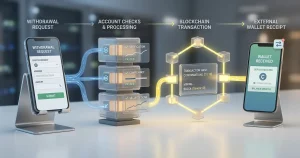
A specialist review reports that crypto withdrawals at VPN-friendly casinos can be processed within minutes to a few hours. That is a reported timing, not a dependable promise: the operator must still process the request, and the exact route offered depends on the casino. Treat any stated processing estimate as something to verify against the site’s current cashier information and terms before relying on it.
For fiat payouts, a specialist review gives a broader estimate of one to five days for e-wallet and bank-transfer withdrawals. It also reports that e-wallet withdrawals take about a day. These are source-reported figures, not a guarantee that every casino will follow the same timetable. Check whether the casino supports the e-wallet or bank account you intend to use, and whether its published estimate describes operator processing or the full transfer.
Crypto Withdrawals
Processed within minutes to a few hours according to specialist reviews.
E-wallet Payouts
Typically take about a day, with a broader estimate of one to five days.
Bank Transfers
Generally processed within one to five days.
Bank-card withdrawals are reported as rare at VPN-friendly casinos. If you expect to withdraw to the card used to fund an account, do not assume that route will be available; look for an explicit withdrawal option instead. A casino may offer a different payout method from the one you used to deposit.
Before requesting payment, compare the available routes and their stated processing times in the operator’s own cashier and terms. A displayed method is not necessarily available for every account or transaction. Where the information is unclear, treat the payout timing as uncertain rather than assuming that a crypto transfer will be immediate or that a bank transfer will match an e-wallet.
What a Casino VPN Does—and Does Not—Protect
A virtual private network, or VPN, routes your internet traffic through a different network and replaces the IP address websites see with one associated with that connection. If the route is outside the UK, this can get around some access restrictions imposed by UK internet service providers. It changes how your connection appears; it does not change who you are or where you are entitled to gamble.
A VPN also encrypts the connection between your device and the VPN service. That can make information harder for hackers or other cybercriminals to intercept while it travels across a network, particularly on an insecure connection. Encryption is a privacy measure, not a guarantee that every part of your online activity is hidden.
A casino can still gather information through other means, including device fingerprints and browser data, and may keep records of IP connections. A VPN therefore does not make a gambling account anonymous or prevent a casino from linking activity to you. Information you provide when registering or using an account is also distinct from the IP address shown to a site.
£1 Minimum Deposit Casinos in the UK: What to Know
These limits matter: a VPN can conceal or alter one signal, but it cannot erase the wider trail created by using a website. Nor does masking an IP address establish that a casino accepts players connecting from the UK. Treat the VPN as a tool for connection privacy, not as a shield against a casino’s checks or its terms.
Casinos That Allow VPN Connections: The Limits of Permission
A casino described as VPN-friendly may accept connections routed through a virtual private network, but that does not establish that it accepts customers in the UK. These are separate questions: an operator can permit VPN access while excluding particular countries in its terms. A connection working today is not proof that your account is eligible or will remain usable.
Read the operator’s terms for both its VPN policy and its list of restricted countries before creating an account or depositing. Policies can change without notice. If the operator later decides that your location or VPN use breaches its rules, it may close your account. Hiding your location can also lead to withheld or confiscated winnings, especially if the terms exclude UK players. Permission to connect is not a promise that a withdrawal will be honoured.
There is another practical difference from using a UKGC-licensed service: offshore casinos do not provide GamStop self-exclusion tools. If you rely on GamStop to prevent access to gambling, an offshore account will not be covered by that protection.
Casino Not on GamStop: Instant Withdrawal Explained
Playing at an offshore casino that allows VPNs also means giving up UK consumer protections. That is a substantial trade-off, not a technical detail. Check who operates the site, where it is licensed and what its terms say about UK residents and VPN connections. If those conditions are unclear or conflict with one another, do not treat the site’s willingness to load through a VPN as reassurance. A working connection confirms only that the site can be reached; it does not settle whether you are allowed to play under its rules.
Can I use a VPN to play at online casinos in the UK?
Yes, using a VPN to gamble online is not criminalised by UK law, and some offshore casinos accept VPN connections. Most UKGC-licensed operators block VPN connections, and playing at an offshore casino means giving up UK consumer protections.
Do VPN-friendly casinos accept cryptocurrencies?
Some do: crypto deposits and withdrawals are available at VPN-friendly casinos. Crypto payments may reduce location checks and KYC friction for small amounts, but they do not prevent casinos from collecting device and connection data.
Do VPN-friendly casinos pay out winnings?
Yes, withdrawals are available, though payment methods and processing times vary. Crypto withdrawals typically take minutes to a few hours, e-wallet withdrawals about a day, and fiat withdrawals by e-wallet or bank transfer 1–5 days.
How do I withdraw winnings from a VPN casino?
Use a withdrawal method offered by the casino, such as crypto, an e-wallet or a bank transfer; bank card withdrawals are rare. You may need to complete KYC checks, particularly after reaching a larger withdrawal threshold.
Is it illegal to use a VPN to gamble in the UK?
No. UK law does not criminalise using a VPN to gamble online, but playing at an offshore casino means you forfeit UK consumer protections.
Material created by the team WSM